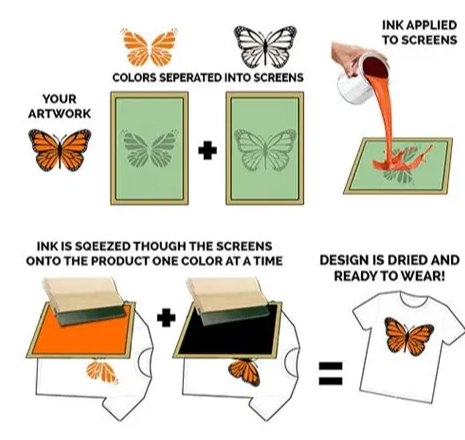
In the screen printing process, the squeegee is mounted in the holder of the screen printer. It presses the screen mesh against the surface of the substrate, allowing the ink to transfer through the mesh openings onto the product surface to achieve printing. The squeegee is the source of printing pressure.
What is the type of screen printing squeegee? How to choose the right screen printing blade?
In the screen printing process, the squeegee is mounted in the holder of the screen printer. It presses the screen mesh against the surface of the substrate, allowing the ink to transfer through the mesh openings onto the product surface to achieve printing. The squeegee is the source of printing pressure.
The material, hardness, and blade shape of a screen printing squeegee directly determine the printing precision, ink layer uniformity, and screen lifespan. Based on differences in structure, material, and function, mainstream squeegees can be divided into the following four categories to suit different printing scenarios:
Classification by Blade Shape (The Most Core Classification Method)
This is the most commonly used classification dimension in screen printing. Different blade shapes directly match different ink properties and substrates.
1.Square (also called Straight Edge): The most often used by screen printers is square-edge squeegee blade. The blade edge is flat and straight, with a rectangular or trapezoidal cross-section. It is the most basic type of doctor blade.
- Applications: Printing on flat substrates: such as paper, PVC film, PCB circuit boards, and metal panels. Transfer of inks of normal viscosity: Compatible with solvent-based and water-based inks, producing a uniform and stable ink layer thickness.
- Advantages: High versatility, long service life, suitable for mass standardized production;
- Disadvantages:Poor adaptability to uneven substrates.
2.V-Shaped (single or double-bevel): This shape is used for printing on uneven or cylindrical-shaped substrates.The blade has a V-shaped groove design, allowing for greater ink retention.
- Applications: Thick ink layer printing: such as large lettering on billboards, reflective signs, and solder resist printing on circuit boards. Specialty ink compatibility: such as metallic inks, glass inks, and PU foam inks; thick film deposition can be achieved in a single squeegee stroke.
- Advantages:Large ink layer thickness, strong three-dimensional effect;
- Disadvantages:High operational difficulty; requires precise control of squeegee pressure, otherwise ink buildup is likely.
3.Double-edged squeegee: Both ends of the squeegee are designed as effective cutting edges, and different hardness or angles can be used.
- Applications: Multi-process mixed printing: When the same product needs to be printed with both fine lines and large areas of color simultaneously, frequent blade changes are unnecessary.
- Advantages: Multi-purpose blade, flexibly adaptable to various needs;
- Disadvantages: High blade maintenance costs, requiring regular sharpening of both sides of the blade.
Classification by Hardness (Shore A)
The hardness of the squeegee determines the pressure transmission and adhesion to the substrate during ink scraping. Squeegees with different hardness are suitable for substrates with different flatness and printing precision requirements. The commonly used hardness range is 60°-90°Shore A.
- Soft Squeegee (60°–70°)
- Advantages: Good adhesion, suitable for uneven surfaces.
- Disadvantages: Easily deformed, not suitable for fine lines.
- Applications: Curved surface printing, rough surfaces, large solid areas.
- Medium-Hard Squeegee (75°–80°)
- Advantages: High versatility, balances hardness and elasticity.
- Disadvantages: No obvious shortcomings.
- Applications: Most offset printing, graphics, circuit boards.
- Hard Squeegee (85°–90°)
- Advantages: Clean squeegee, clear lines, suitable for fine dot printing.
- Disadvantages: Requires high substrate flatness, easily damages the screen.
- Applications: High-precision printing, circuit boards, halftone printing.
Classification by Structure
The structural design of the squeegee affects its rigidity, flatness, and performance compatibility. Common structural types include single-layer, multi-layer/sandwich, and metal mesh, each adapted to different printing sizes and precision requirements.
- Single-layer squeegee
- Advantages: Single-layer squeegees are made of a single material and of uniform hardness, resulting in a simple structure, low manufacturing cost, and affordable price.Easy to use and maintain, suitable for general printing scenarios such as small-scale advertising printing and simple packaging printing.
- Disadvantages: Single-layer squeegees have limited performance and cannot simultaneously balance elasticity and rigidity, making them unsuitable for high-precision or complex printing needs. They are prone to deformation and uneven ink application in long runs or fine printing.
- Multi-layer/Sandwich Squeegees
These are typically made of two or three layers of materials with different hardnesses bonded together. A common design is a hard middle layer and soft side layers.
- Advantages: This structure combines the elasticity of a soft squeegee with the rigidity of a hard squeegee, ensuring both good adhesion during ink scraping and high printing accuracy. It results in cleaner ink scraping and less damage to the screen.
- Disadvantages: Multi-layer squeegees are complex to manufacture and expensive. They are mainly suitable for high-precision, high-requirement industrial printing applications, such as high-end electronic product printing and fine packaging printing.
- Metal-Mesh Squeegee:
A metal-mesh squeegee has a metal mesh or sheet embedded in the middle of the squeegee strip. Its core advantage is its extremely high rigidity, ensuring the squeegee remains absolutely straight and will not bend or deform. It is suitable for ultra-wide format printing, such as large-format billboards and glass curtain wall printing. The metal mesh structure also enhances the squeegee's wear resistance and lifespan, ensuring uniform ink layer coverage during wide-format printing.

When selecting a screen printing squeegee, it is necessary to comprehensively judge based on key factors such as printing materials, ink type, pattern precision, and substrate shape. The following are targeted selection suggestions:
- For general graphic printing and routine printing on plastic/metal parts: Prioritize 75°-80°Shore A, beveled edge, rubber or polyurethane single-layer squeegees, balancing performance and cost;
- For high-precision printing, fine line/dot printing, and long-run printing: Recommend 85°-90°Shore A, sharp corner/double beveled edge, polyurethane multi-layer squeegees to ensure printing precision and lifespan;
- For curved surface printing, uneven surface printing, and large solid area printing: Use 60°-70°Shore A squeegees. A. Flat or rounded corner, nitrile rubber squeegees improve adhesion and ink coverage;
- High-temperature processes and heat transfer printing: silicone rubber squeegees are selected to meet high-temperature resistance requirements; Ultra-wide format printing (such as billboards and glass curtain walls): metal mesh squeegees are used to ensure squeegee straightness and printing uniformity.
In short, squeegee selection is a comprehensive balancing process. It requires precise matching based on actual printing needs from four dimensions: hardness, shape, and structure, to maximize the advantages of screen printing and achieve high-quality, high-efficiency printing production.
